




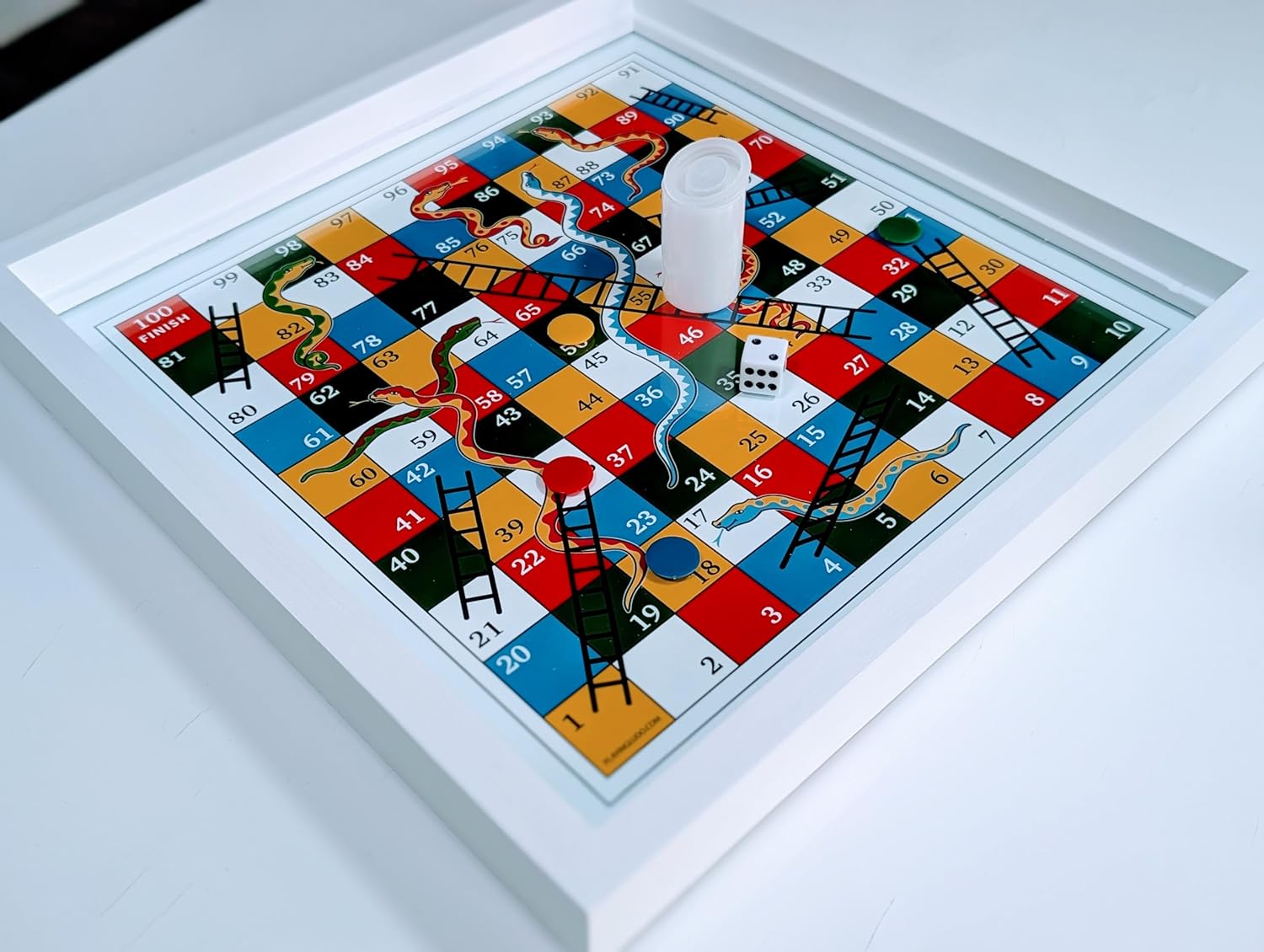


Real Glass Top Game Board with Chess, Checkers, Backgammon, Ludo (Caribbean & Indian), Chausar, Pachisi, Tic-Tac-Toe, Snakes and Ladders, and a Drinking Dice Board Game.

 4.2 (86 items)
 Limited Time Sale
US$34.80 cheaper than the new price!!
Free cash-on-delivery fees for purchases over $99
Product details
| Management number | 211939891 | Release Date | 2026/04/06 | List Price | US$23.20 | Model Number | 211939891 | ||
|---|---|---|---|---|---|---|---|---|---|
| Category | |||||||||
This Board Game, which measures 17x17 inches and features a real glass top, This is a fantastic collection of games, offering a wide range of experiences from ancient strategy to modern party fun! Here's a description of each: Classics: Chess: A two-player strategy board game played on an 17x17in checkered board. Each player controls 16 pieces of varying movement capabilities (king, queen, rooks, bishops, knights, and pawns). The objective is to checkmate the opponent's king, meaning the king is under attack and has no legal move to escape. Chess is renowned for its deep strategic complexity and requires foresight, tactical planning, and pattern recognition. Checkers (Draughts): A two-player strategy board game played on an 17x17in checkered board . Players move uniform disc-shaped pieces diagonally forward on dark squares. The objective is to capture all of an opponent's pieces by jumping over them, or to block them so they have no legal moves. Pieces that reach the opponent's back row become "kings" and can move and capture both forwards and backwards. Backgammon: A two-player game played on a board with 24 narrow triangles (points) and a dividing bar. Each player has 15 checkers that they move along the points according to the roll of two dice. The goal is to be the first player to move all of their checkers off the board. It combines strategy with an element of luck from the dice rolls, involving decisions about blocking, hitting opponent's pieces, and bearing off. Fun Variations: Ludo: A simplified version of Pachisi, popular around the world. Players race four tokens from a starting area around a cross-shaped board to a central "home" area. Movement is determined by the roll of a single die (or two dice in some variations). A roll of a six (or one and a six in some Indian variations) is often required to move a token onto the main track, and rolling a six grants an extra turn. Landing on an opponent's token sends it back to its starting area. Caribbean Ludo (Ludi): This is essentially Ludo as it's played in the Caribbean, particularly Jamaica. While the core rules are the same as standard Ludo (cross-shaped board, four pieces per player, dice rolls to move, race to home), there can be unique "house rules" or cultural variations that add flavor. These might include specific entry rules, variations for rolling doubles, or additional safe zones. It's often a significant social activity. Indian Ludo: The original Ludo, often played with two dice. Key differences from standard Ludo can include: Safe Squares: Specific squares (often marked with a star) in each quadrant are safe from capture. Two Dice: Playing with two dice allows for more strategic movement combinations. Entry on 1 or 6: Some variations allow a token to enter play if a player rolls a 1 or a 6. Backward Movement: In some Pakistani variations, backward movement is allowed. Blocked Spaces: Landing on your own piece can create a "block" that opponents cannot pass. Chausar: An ancient Indian cross-and-circle game, closely related to Pachisi. It's typically played by four players, often in two teams, using cowrie shells (instead of dice) to determine moves. The board is cross-shaped, and players race four pawns around the board and into a central "home" area. Chausar features special rules for forming "juda" pairs (stacked pieces) and specific scores from the cowrie shells (e.g., 1, 2, 3, 4, 5, 6, 12). There are no "safe" squares on the main path, making it quite aggressive. Pachisi: Considered the "national game of India" and the historical predecessor to Ludo and Parcheesi. It's a cross-and-circle board game for four players, often played in partnerships. Players use cowrie shells to determine their moves, racing four pieces each around a cross-shaped track. It includes "castle" squares where pieces are safe from capture. The objective is to be the first partnership to get all their pieces to the center space. Tic-Tac-Toe: A very simple two-player game played on a 3x3 grid. Players take turns marking a square with their symbol (X or O). The first player to get three of their marks in a row (horizontally, vertically, or diagonally) wins. It's a game of perfect information, meaning a perfect strategy can lead to a draw if both players play optimally. Snakes and Ladders: A simple race game for two or more players, played on a numbered grid. Players roll a die and move their counter along the grid. If they land on a square with the bottom of a ladder, they move up to the square at the top of the ladder. If they land on a square with a snake's head, they slide down to the square at the snake's tail. The objective is to be the first player to reach the final square. It's almost entirely luck-based. Drinking Dice Board Game: While "Drinking Dice Board Game" is a broad category, it often refers to variations of Liar's Dice (also known as Perudo, Dudo, or Snyde). In this game, each player has a set of dice and a cup. Players roll their dice secretly and then take turns making bids about the total number of a specific die value under all the cups on the table. Players can either make a higher bid or call a bluff. If a bluff is called, the dice are revealed, and the person who was incorrect (either the bluffer or the caller) typically takes a drink. It's a game of bluffing, probability, and deception, and adding a drinking penalty makes it a party game.
- Glass Top Ludo Game
| Size | 17x17 inches |
|---|---|
| Color | White |
| Genre | Family, Party |
| Theme | No Theme |
| Edition | Standard Edition |
| Brand Name | Generic |
| Item Weight | 16 ounces |
| Material Type | Wood |
| Operation Mode | manual |
| Item Dimensions | 17 x 17 x 0.1 inches |
| Number of Items | 1 |
| Is Assembly Required | No |
| Educational Objective | Enhance cognitive skills, social interaction, and strategic thinking |
| Item Dimensions L x W | 17"L x 17"W |
| Are Batteries Required | No |
| CPSIA Cautionary Statement | Choking Hazard - Small Parts |
| Manufacturer Maximum Age MONTHS | 1200 |
| Manufacturer Minimum Age MONTHS | 60 |
Bestseller ranking
Board Games


Correction of product information
If you notice any omissions or errors in the product information on this page, please use the correction request form below.
Correction Request Form